Best Australian Yarns by Haynes Jim
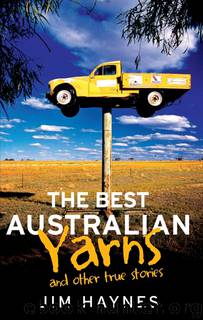
Author:Haynes, Jim
Language: eng
Format: epub
Tags: ebook, book
ISBN: 9781743435854
Publisher: Allen & Unwin
Published: 2013-11-04T05:00:00+00:00
THE ‘FAILURE’ THAT SUCCEEDED
Mildura Irrigation Colony
Mildura, on the Murray River in the Sunraysia District, is an area with a fascinating and unique history.
In the early 1880s, the Victorian government began examining the idea of irrigation colonies on the Murray River. In 1884, Victorian Premier Alfred Deakin led a delegation to the USA and met the Canadian brothers George and Ben Chaffey, who had established irrigation colonies in Ontario and California.
George Chaffey visited Victoria in 1886 and, having decided on the Mildura Run as a suitable location for an irrigation colony, the Chaffeys sold their Californian interests at a loss in order to invest in this new venture.
The Mildura Run was in liquidation. It had a river frontage of 64 kilometres and reached 32 kilometres back with flats subject to frequent flooding. One squatter called it ‘the most wretched and hopeless of all the Mallee regions’ and another ‘a Sahara of blasting hot winds and red driving sands, a howling, carrion-polluted wilderness’.
In 1886, after months of negotiations, the Chaffey brothers signed an agreement, which was rejected by the Victorian parliament. The property was put up for public tender, but the Chaffeys decided not to tender. Instead, they negotiated with the South Australian government and, on 14 February 1887, they signed an agreement securing 250,000 acres at Bookmark Plains which went on to become the town Renmark.
The Victorian government received no suitable tenders and finally ‘The Chaffey Brothers Agreement’ was passed in May 1887. An indenture was signed for 250,000 acres of the old Mildura Run, which the Chaffeys took possession of in August. 50,000 of them were at £5 per acre to be subdivided into cleared 10-acre blocks between irrigation channels and a further 200,000 acres at £1 plus water rights to the equivalent of a 24-inch rainfall.
This amounted to 1699 cubic metres per minute, approximately one third of the Murray’s lowest rate of discharge in drought.
Prospective settlers or investors could purchase irrigated blocks for £20 per acre (0.4 hectares) and Chaffey Brothers Ltd managed blocks for absentee owners for a fee of £5 per annum. George Chaffey, who was an engineer, had pumps capable of delivering up to 40,000 gallons per minute to main channels built and installed and the Chaffeys invested in brickworks, an engineering company, a timber mill and, in 1888, the River Murray Navigation Company.
In the early years, favourable conditions meant Mildura could rely mostly on river transport with freight and passengers going downstream for a railway connection to Adelaide, and upstream to Swan Hill and Echuca for connections to Melbourne.
Pests such as locusts damaged crops and there were continual problems with the irrigation. When water rates of fifteen shillings per acre (0.4 hectare) were introduced in 1891, settlers who had suffered three years of failed crops could not afford to pay and the Chaffeys shut down the pumps, labourers struck for better wages and conditions and were sacked and many men working for blockholders were never paid.
When Alfred Deakin and members of a Royal Commission arrived
Download
This site does not store any files on its server. We only index and link to content provided by other sites. Please contact the content providers to delete copyright contents if any and email us, we'll remove relevant links or contents immediately.
The Tidewater Tales by John Barth(12639)
Kathy Andrews Collection by Kathy Andrews(11793)
Tell Tale: Stories by Jeffrey Archer(9010)
This Is How You Lose Her by Junot Diaz(6855)
The Mistress Wife by Lynne Graham(6465)
The Last Wish (The Witcher Book 1) by Andrzej Sapkowski(5443)
Dancing After Hours by Andre Dubus(5267)
The Sympathizer by Viet Thanh Nguyen(4370)
Be in a Treehouse by Pete Nelson(4017)
The Secret Wife by Lynne Graham(3901)
Maps In A Mirror by Orson Scott Card(3877)
Tangled by Emma Chase(3738)
Ficciones by Jorge Luis Borges(3614)
The House on Mango Street by Sandra Cisneros(3448)
A Knight of the Seven Kingdoms by George R R Martin(3299)
Girls Who Bite by Delilah Devlin(3242)
You Lost Him at Hello by Jess McCann(3056)
MatchUp by Lee Child(2867)
Once Upon a Wedding by Kait Nolan(2779)
